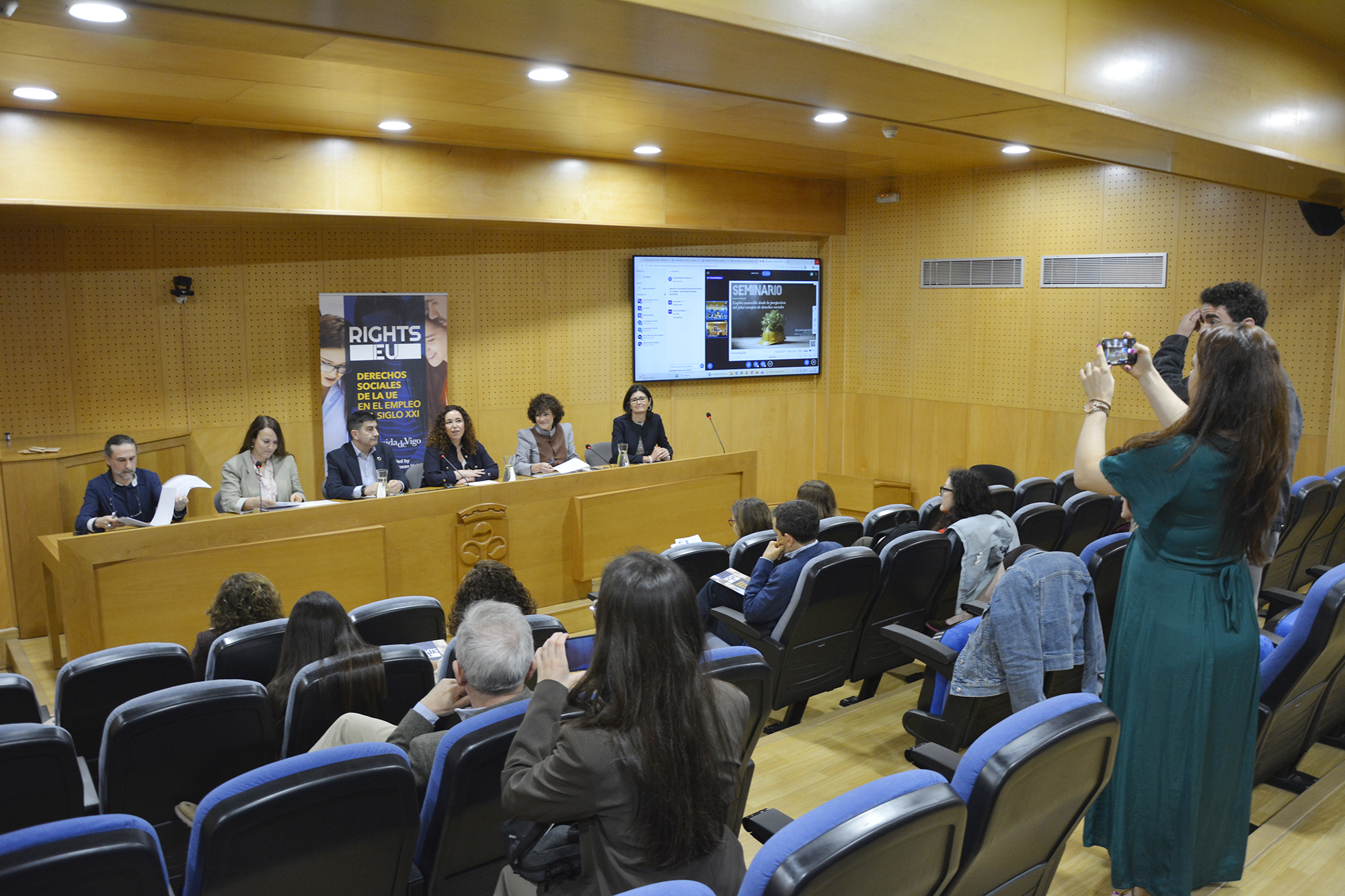
Convert vocational training teachers into ambassadors of the EU, transmitters of its objectives and its functioning and, above all, two social and labor rights of citizenship. This is the purpose of the European project RightsEU, The central role of the European Union’s social rights in employment in the Twenty-First Century (O papel central dos dereitos sociais da Unión Pública no emprego no século XXI), which has just been awarded to UVigo not under the Jean Monnet program. This initiative, which was officially presented this morning in the Redeiras building, is intended to respond to issues identified regarding two essential democratic values of the European Union. The objective, as explained to its coordinator, Emma Rodríguez, professor in the Work and Social Security Area, is “to address these specific needs that contribute to building diverse and inclusive societies through education and reflection in a sustainable endeavor.” Specifically, RightsEU will focus on training teaching staff at vocational education and training (VET) centers through the planning, organization and delivery of EU-specific content. This includes a focus on promoting and encouraging essential aspects such as equality and non-discrimination, digital transformation and artificial intelligence, the climate crisis, the green enterprise, common values, civic engagement and social inclusion.

Training to address challenges
According to Rodríguez, “education and training systems need a transformation to address the challenges presented by the new emerging production and consumption systems. However, as a beneficiary of these new values, it requires professionals trained in competencies and skills closely related to the social rights of the European Union. “Digitalization, the green effort, equality and inclusion are the main references of this project, which aims to integrate and reinforce these concepts in the educational paths of two programs and two Vocational Training (FP) centers.” To achieve these objectives, the project will have a budget of 375,000 euros and a duration of 36 months. They are involved in the initiative of the Coia Integrated Vocational Training Center of Vigo, the Carballeira Integrated Vocational Training Center of Ourense and trainers of the Centro de Emprendemento e Formación Profesional de Viana do Castelo in Portugal, which, according to the coordinator, “will allow teachers to work with students of diverse profiles in their training paths, an important gender segregation, as well as students of diverse ities and circumstances you professional “This cross-border issue is particularly crucial in the future careers of these students.” In the presentation ceremony, the Vice Chancellor of Research, Innovation and Transfer, Belén Rubio, stressed that education is key “to build a more inclusive, digital and sustainable future and this project strengthens this vision” making special efforts for equal opportunities and a non discrimination, digital transformation and artificial intelligence in the climate crisis. Rubio also highlighted the experience and extensive background of two members of the DMT research group, Mercantile and Labor Law, led by Professor Jaime Cabeza, who are involved in this project.

Nine microcourses and 22 teachers from different universities
Specifically, RightsEU aims to provide eminently practical training so that these trainers implement these European principles and social rights in their curricular or extracurricular programs and thus transmit and make them easily accessible to people in training for access or return to the labor market. In total, the project will include nine 25-hour microcourses (three each year), or 225 hours of training, which will be recognized with the corresponding microcredentials. To this we must add nine organizational meetings, three specific workshops and three congresses or expert seminars. 22 expert teachers from both the University of Vigo and other institutions will participate and will provide training in both face-to-face and online modalities, to adapt to the needs of the VET teachers involved. Through all these training actions, RightsEU seeks to address the transfer of knowledge demanded by VET teachers and society from higher education institutions and research institutions and to implement training courses with a duration adapted to the limited availability of recipients, focusing on specific social values and rights for these teachers. It is also about promoting equal opportunities and access to VET between men and women through teacher training, applying the EU values of equality, inclusion, diversity and equity and implementing the necessary knowledge on the rights of cross-border workers as an opportunity. potential employment from the stage of professional training. In addition, VET centers will also be supported in the creation or transformation of digital systems to adapt to new training needs and promote high-quality digital education, inclusive and accessible to all, benefiting the most vulnerable groups and providing ethical guidelines to teachers on or use of artificial intelligence is not just. Finally, it also seeks to promote digital vocational training in rural areas as an effective means of retaining the population once the educational stage is completed.
A pioneering Jean Monnet project with its cross-border character
Eva Garea, director of UVigo’s International Education Projects Area, explained in the presentation that RightsEU was selected within the framework of the Jean Monnet program, “I love UVigo because it finances initiatives that allow for better EU, its institutions, policies and Above all, the values of democracy, peace, respect, equality…” The project was two 13 awarded in this call among a total of 35 candidatures presented, also becoming the two largest awarded to UVigo within Jean Monnet. Furthermore, Garea, has the peculiarity of being the first to have a cross-border character and also stands out for being directed “more than just the university education, focusing on adult education, vocational training and lifelong learning, one of those “EU priorities”.